

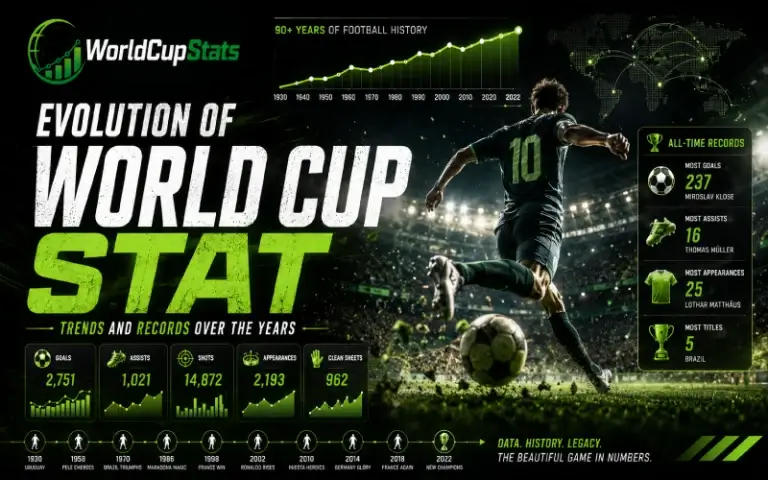
The FIFA World Cup has evolved from a simple international football tournament into a global data powerhouse where every pass, shot, and goal is tracked, analyzed, and used for predictions. For modern football fans-especially Filipino bettors who are increasingly active in online sports betting-World Cup stat are more than history; they are tools for smarter wagering decisions.
From the early editions in 1930 to the modern high-tech era of analytics, the evolution of World Cup stat trends reveals how football has become faster, more tactical, and more data-driven than ever before.
The Rise of Data in World Cup Football
In the early World Cup tournaments, statistics were basic-goals scored, match results, and title winners. Today, advanced metrics such as expected goals (xG), possession value, pressing intensity, and shot conversion rates define how teams are evaluated.
Modern tournaments now produce millions of data points per match. Analysts, coaches, and bettors rely on these numbers to predict outcomes with higher accuracy. This shift has made football not just a sport of passion, but also a sport of probability.
For Filipino bettors, understanding these trends can be a game-changer when placing bets on match winners, over/under goals, or correct scores.
Evolution of Scoring Patterns and Match Trends
One of the biggest changes in World Cup history is how goals are distributed. In earlier decades, matches were often low-scoring, with defensive strategies dominating. However, recent tournaments have seen a rise in attacking football, with faster transitions and more aggressive pressing.
For example, modern World Cups regularly average higher goal counts per match compared to the 1990s and early 2000s. This increase is partly due to rule changes, improved player fitness, and more attacking formations like 4-3-3 and 3-4-3 systems.
Teams like Brazil, France, and Argentina have consistently contributed to this attacking evolution, producing some of the highest-scoring games in recent history. This trend is crucial for bettors who focus on over/under markets, as goal-heavy matches are becoming more common.
Record-Breaking Players and Tournament Legends
World Cup history is also defined by iconic players who have rewritten scoring records. Legends such as Miroslav Klose, Ronaldo Nazário, and Lionel Messi have shaped the tournament’s legacy through consistent performances across multiple editions.
In recent years, younger stars have continued to push these records further, making the tournament more unpredictable for bettors. Player form, injury status, and knockout-stage performance all play a major role in betting outcomes.
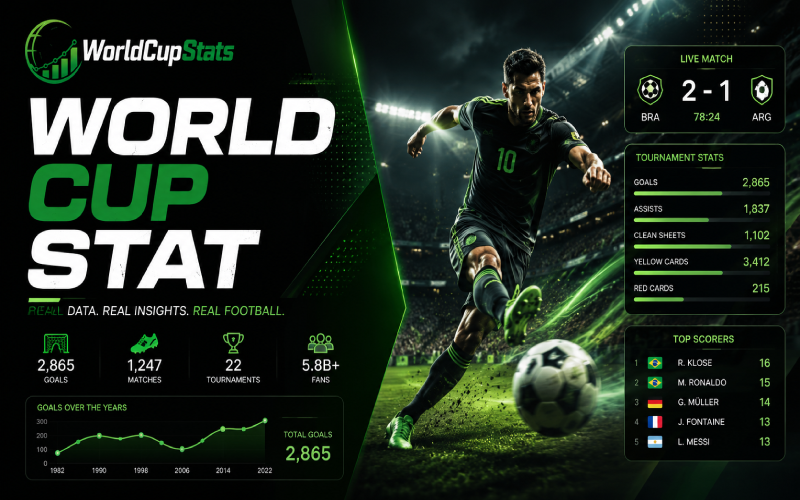
For those tracking long-term performance trends, platforms like analytics tools and data trackers-including sites inspired by models like understat world cup-help bettors break down player efficiency beyond just goals scored.
Betting Insights for Filipino Bettors
In the Philippines, football betting has grown significantly thanks to easier access to online sportsbooks and live in-play markets. World Cup matches are especially popular due to their global appeal and high liquidity in betting markets.
To bet smarter, Filipino bettors should focus on several statistical trends:
- Team form and recent performance – Teams entering the World Cup with strong qualifying records often perform well in group stages.
- Goal expectancy trends – High xG teams tend to outperform traditional rankings.
- Head-to-head history – Past matchups can reveal tactical advantages.
- Player dependency – Teams relying heavily on one striker are riskier in knockout rounds.
By combining these stats, bettors can reduce guesswork and improve long-term profitability.
Tactical Evolution and Defensive Metrics
While attacking football has become more dominant, defensive metrics have also become more advanced. Modern teams are not just judged by goals conceded, but by defensive actions such as interceptions, blocks, and successful pressing sequences.
This evolution means that low-block defensive teams can still succeed if their structure is statistically efficient. For example, teams that concede fewer high-quality chances often outperform expectations in knockout stages.
This is particularly important for bettors who rely on underdog betting strategies. A statistically strong defensive team can often upset higher-ranked opponents.
Technology, Analytics, and the Modern World Cup
Technology has transformed how World Cup data is collected and used. AI-driven models now predict match outcomes based on thousands of simulations, factoring in player fatigue, tactical matchups, and historical performance.
Live betting markets also rely heavily on real-time stats, allowing bettors to react instantly to changes in momentum. This creates opportunities for in-play betting strategies, especially during high-pressure knockout matches.
For Filipino sports bettors, this means the World Cup is no longer just about predicting winners-it’s about understanding probabilities in real time.
Conclusion
The evolution of World Cup stat reflects the broader transformation of football into a data-driven sport. From simple goal counts to advanced predictive analytics, every era has added new layers of insight for fans and bettors alike.
For Filipino bettors, mastering these trends can provide a competitive edge in betting markets, especially during high-stakes World Cup matches. Whether analyzing team form, tactical shifts, or player efficiency, statistics are now the foundation of smarter betting decisions.
As the tournament continues to evolve, one thing is clear: data will only become more important, and those who understand it will always have an advantage.